



















































































SHIPPING FISH THREE THOUSAND MILES TO MARKET.
By E. D. CLARK, Bureau of Chemistry. 1915
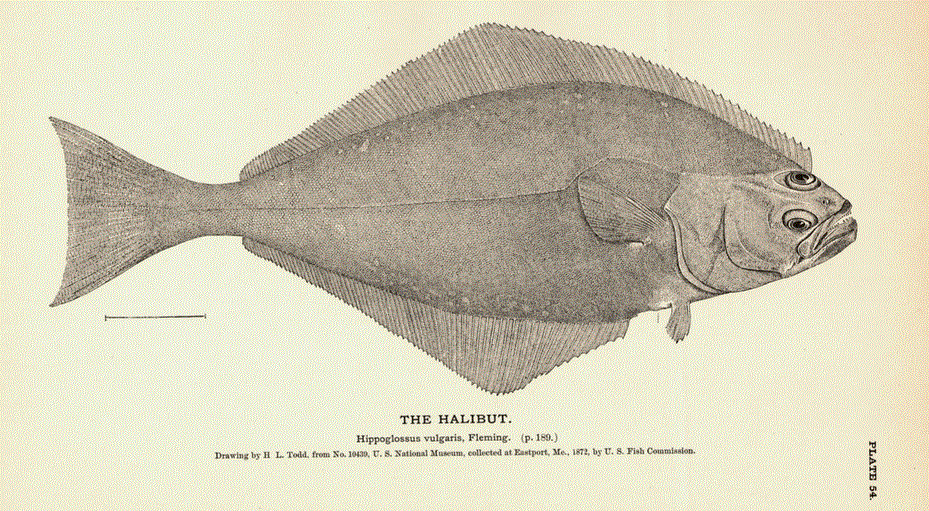
MILLIONS of pounds of halibut and salmon are shipped each year across the United States from the Pacific to the Atlantic coast. Few of the persons who help to consume this vast supply realize that the fish has come overland. They imagine that its freshness is due to their own proximity to the ocean and believe that if they were so unfortunate as to live far inland good sea food would be unattainable. As a matter of fact, it is the Pacific, not the Atlantic, which now furnishes the bulk of the salmon and halibut consumed in the country. For various reasons the Atlantic catches have diminished to such an extent in recent years that the supply from this source would be quite insufficient to supply even the large cities along the coast itself. On the other hand, the catches in the Pacific are enormous. The fisheries of Alaska alone yield annually products that are valued at two or three times the $7,000,000 paid to Russia in 1867 for the Territory, and the annual output of the Pacific salmon canneries is valued at $30,000,000. Sixty million pounds of fresh halibut alone were shipped east last year.
Refrigerator cars and artificial freezing have made possible the development of an industry which now regularly supplies even New England, the traditional home of American fishing, with fresh fish from the far West. At first the Pacific fishermen canned their salmon and sold what they could of their halibut to the local markets. The latter, however, could not begin to make away with all that the ocean offered. There were more fish than people to eat them and it was not until the possibility of sending them across the continent had been demonstrated that the Pacific fisheries became really profitable.
To-day fast express trains carry carloads of fresh salmon and halibut from the Pacific to the Atlantic in from 5 to 7″ days. Packed carefully in ice from the time they leave the waters of the northern Pacific to the moment they are delivered to the consumer, these fish when they appear upon the table are practically indistinguishable in flavor and appearance from those that have been caught a few hours’ sail away. From 20,000 to 24,000 pounds of fish are hauled in each car, so that the value of the shipment is sufficient to justify, from a business point of view, the care that is indispensable if it is to reach the market in good condition.
Though halibut and salmon are frequently shipped in the same cars, they are usually packed somewhat differently. When the halibut boats reach the docks, the fish are swung out of the hold in large rope nets caught up by the four corners. These nets are swung over to the” heading tables” and the fish dumped out. There they are decapitated, the operators hooking each fish with the left hand and slicing off the heads with a large knife held in the right hand. The headless fish, which have already been cleaned on board ship, are then packed in large boxes, the bottoms of which are covered with layers of cracked ice. More ice is placed upon the fish before the boxes are nailed down. From 350 to 450 pounds are packed in each box. Salmon, on the other hand, are brought to the shippers in smaller lots and they are packed in smaller and flatter boxes than the halibut. Before packing, moreover, the fish are gone over very carefully and any defect, such as soft flesh or lack of brightness, results in their rejection (PI. XIV, fig. 1). Shipments for the Atlantic coast are usually packed undressed; other fish are cleaned first. As soon as they are filled, both salmon and halibut boxes are stored away in the refrigerator express -cars waiting for them on the docks. These cars have already been thoroughly cooled by the ice in their bunkers and more ice is thrown over the boxes before the car is closed for its journey. The temperature in the interior is thus reduced to a point so low that comparatively little of the ice melts on the road, but icing stations are distributed along the route and the supply in the car is renewed from time to time.
Although these methods have succeeded in making practically the entire country an accessible market for Pacific fish, the supply is so great at certain seasons of the year that it has become necessary to devise other means to prevent a large part of the yield from going to waste. Accordingly, great quantities of both salmon and halibut are now frozen and kept in cold storage to be marketed during the
winter, when fresh fish of these species are not available. (See PI. XV.)
In preparing fish for the freezer the first step is to wash off all blood and slime. This is never done with fish shipped in ice, because the slime has been found to assist materially in excluding the air and consequently in keeping the fish in good condition. With frozen stock, however, the protective covering of slime is not desirable, its purpose being better served by a thin glaze of ice. From 12 to 24 hours in the “sharp freezer,” where the fish rest on brine pipes in a temperature of zero or less, turns the salmon and halibut into a substance that is almost as hard as stone. To store them in this condition, however, would result in their gradually turning white through loss of moisture; while the action of the air would cause deterioration and change in flavor. To prevent this the fish are dipped several times in water in a room so cold that a thin film of ice forms around them, sealing them hermetically and permanently. Thereafter, if kept at a temperature below freezing, the fish remain for months unchanged in appearance or flavor. The instant they are permitted to thaw, however, deterioration begins. It is, therefore, much to be regretted that the popular prejudice against cold-storage products in general, and frozen fish in particular, tempts many retailers to thaw out their stock and dispose of it to customers as fresh fish. Although it is true, of course, that fresh stock always brings a higher price than frozen, it is probable that the consumer’s
prejudice, which not infrequently keeps him from buying frozen fish at any price, is more responsible for this practice than the dealer’s desire to obtain a little extra money by selling goods under false pretenses. Furthermore, the dealer buys his own supplies of frozen fish at prices which fluctuate widely. He is, however, prevented by the existing prejudice from reflecting to any great extent these fluctuations in the prices at which he sells and he is thus unable to stimulate in this way the demand for his goods. As a matter of fact, both practical experience and scientific retains its flavor and its food value for a long time. There is no reason why anyone should hesitate to eat it and a more general consumption would be profitable to fisherman, dealer, and consumer alike.
At present the annual demand for frozen fish amounts to about 13,000,000 pounds of salmon and steelhead trout, popularly classed with salmon, and 20,000,000 pounds of halibut. Early in the season, when the salmon and trout are still outside of the large rivers and have to be caught by trawling, practically all of the catch is marketed fresh. After the fish have gone up the rivers to spawn, however, seines (PI. XVI, figs. 1 and 2), gill nets, revolving fish wheels, and traps of many kinds furnish snch large yields that the bulk of the sea harvest is either canned or frozen for consumption in the winter, when no ,fresh salmon are available. Halibut, on the other hand, is always caught by trawling, both sailboats and steamers being employed in the industry, though steam is coming more and more into favor.
The growth of the business and the migratory habits of the fish have resulted in a constant search for new halibut banks, which is now carried on as far northward as Kodiak Island and as far to the south as the Oregon coast. The actual fishing is done from small dories, a number of which are carried by each parent vessel. These dories, each about 20 feet long, have a crew of two men. The trawl, or fishing gear, consists of hundreds of hooks on long lines, which, if connected together, would sometimes attain a length of several miles. This is baited with herring, squid, etc., and dropped overboard. On populous banks the halibut bite readily and the dory’s crew is kept busy hauling in the lines. When the net in the bottom of the dory is filled to its capacity, the parent vessel is signaled to come alongside and take off the catch (PI. XIV, fig. 2). Once on board the larger boat, the fish are cleaned immediately and their bodies filled with ice and stored in an ice-chilled hold until the cruise is over.











![50 Watt 4 Stage Hi-Fidelity Power Amplifier Circuit and Parts List [The Basic Schematic of Most Low Cost Tube Guitar Amps Made Today]](https://countryhouseessays.com/wp-content/uploads/2026/02/5R4GYB-Tube.gif)