|
|
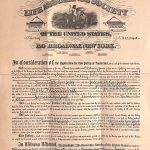
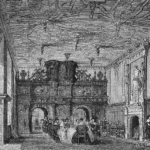
February 24th, 2026  A $10,000 life insurance policy written by the Equitable Life Assurance Society of the United States for President James A. Garfield. It was signed on the 22nd of June, 1881, 9 days before President Garfield was shot by Charles J. Guiteau on July 2. From How to Make Money; and How to Keep it, Or, Capital and Labor based on the works of Thomas A. Davies Revised & Rewritten with Additions by Henry A. Ford A.M.
CHAPTER XXVII.
LIFE INSURANCE.
It is an unselfish, generous act when one takes out a life policy to protect his family. Not only this, but he is doing his simple duty. ANONYMOUS.
The Life Insurance system has been for two centuries a positive force in the progress of modern civilization and the accumulation of national wealth. It has been an important educational factor in every community, which it has influenced in habits of economy, prudence, and providence. And it stands to-day side by side with the savings-bank and the trust company, sharing the confidence with which men who seek the welfare of their fellows crown all three. Rev. STEPHEN H. TYNG Jr.
THE origin of life insurance is attributed to the Rev. Wm. Anhote, D. D., of Middleton, Lancashire, England, who opened a public office about two hundred years ago, for the benefit of widows, especially those of clergy men, and for the settling of jointures and annuities. In 1698, the “Mercers’ Company” began to assure lives for the benefit of widows; and in July, 1806, under charter from Queen Anne, the “Amicable Society, or Perpetual Assurance,” opened the first general office. Within a century and a half from that time, about one hundred life companies were founded in the United Kingdom. In 1820 the ” Hospital Life Insurance Company,” first in this country, began its operations in Boston. Twenty-three years afterwards the first mutual companies were founded in that city and in New York. The number of life companies in the United States is now very large, and the system of late years has had an enormous development. It has become a highly important feature in the financial world; and its object is of a nature likely to commend it to every thinking mind. We have before insisted that it is the moral and political duty of every one so to arrange his affairs that he shall under no circumstances become a burden upon the public or his friends: we now say that this branch of finance offers the best way in which such result can be obtained. For if the man be alone in the world, with no one dependent upon him, it can be shown that he will accumulate for himself as fast in some other way on small amounts, while if he has others dependent upon him, this is the only way by which an independence can certainly be assured to them.
However industrious, prudent, and saving one may be under circumstances that protect him and his, Death stands at his door to put an end at any time to such efforts, however well directed. From the responsibilities of this end there is but one loophole of escape, but one way by which the man thus situated may see his way clear, and conquer even the efforts of Death to thwart him. Life insurance meets the case; and while it does this effectually, if at the same time it accomplishes the further end of causing money to make money to the best advantage, it is still better. But if, again, it shows how to do this, and also to keep the accumulations, a treble triumph is won; and three problems harder to solve are not found in the whole range of finance. If, then, their solution can be accomplished by the most simple and untrained of financiers, this may be said to be the El Dorado of the protector’s hope, if not of the unskilled money-maker and hoarder of his gains.
Let anyone, then, who has such obligations upon him, consider well their binding force, politically and socially, even if he have no promptings of love or gratitude to the same end. As an anonymous writer has put it, “What a neglect of duty it is for a head of a house to go uninsured! Probably more than two-thirds of the families in any community are dependent for their subsistence upon the daily earnings of the husband or father. Precarious, indeed, must that subsistence be, which hangs wholly and absolutely upon one life–that of the father. When he ceases to exist, not only a parent dies, but a fortune perishes. Then is his life-the mint-closed to those who drew from it. How deplorable such a state of things must be when so many sudden deaths occur ! “
Let the husband and father look over the following mortality table, and see what his expectancy of life is. It will in all probability arouse him to sudden and energetic action in the right direction, before his opportunities are past with no chance to retrace or amend his ways.
April 6th, 2018 
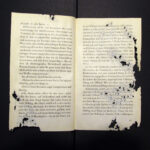
The following cure was found written on a front flyleaf in an 1811 3rd Ed. copy of The Sportsman’s Guide or Sportsman’s Companion: Containing Every Possible Instruction for the Juvenille Shooter, Together with Information Necessary for the Experienced Sportsman by B. Thomas.
Transcript:
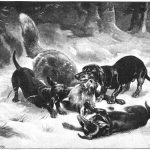
Vaccinate your dogs when young with the Cow pox by introducing the matter with a lancet on the fleshy part of the fore leg — taking care to have it effectually introduced and rubbed in, first clearing away the hair, sot that it may not obstruct the Lancet — mind that the pustule stands in duo time, and the disorder has taken effect.
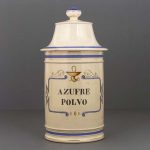
Give a dose of Sulphur every other day for 3 days — immediately after the scab of the pustule is dead.
Mr. Windus has tried it, and has no doubt of it’s proven the distemper in dogs.
April 5th, 2018 
From A History of Fowling, Being an Account of the Many Curios Devices by Which Wild Birds are, or Have Been, Capured in Different Part of the World by Rev. H.A. MacPherson, M.A.
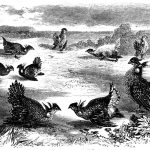
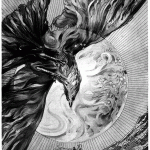
THE RAVEN (Corvus corax) is generally accredited with a large endowment of mother wit. Its warning croak is usually uttered long before an expectant fowler has approached within several hundred yards of its nesting haunt. But even the bird of darkness is sometimes worsted by the craft of its human enemies. The modern Greenlander destroys the Raven with a shot-gun. Continue reading A History of Fowling – Ravens and Jays
April 12th, 2018 
IN MEMORIAM
JOHN WILLIAMS WHITE
The death, on May 9, of John Williams White, professor of Greek in Harvard University, touches a large number of classical workers who have come into relations with him through his teaching or his writings, and concerns many a student, past or present, who may not have known his name, or a word of the language and literature which he professed. Continue reading The First Greek Book by John Williams White
April 3rd, 2018 
The following are transcripts of two letters written by the Founding Father Thomas Jefferson on the subject of seed saving.
“November 27, 1818. Monticello. Thomas Jefferson to Henry E. Watkins, transmitting succory seed and outlining the culture of succory.” [Transcript]
Thomas Jefferson Correspondence Collection
Collection 89
Dear Sir,
Your fav[ou]r of the 6th. did not get to hand till the 23d. and I now with pleasure send you as much of the succory seed as can well go under the volume of a letter. as I mentioned to our colleagues at the Gap, I had forgotten which of them expressed a willingness to try this plant, and therefore I have waited for their application having taken care to have a plenty of seed saved. Continue reading Thomas Jefferson Correspondence – On Seed Saving and Sharing
April 2nd, 2018 
Muscadine Jelly
6 cups muscadine grape juice
6 cups sugar
1 box Kraft Sure Gel or Ball Fruit Jell Continue reading Muscadine Jelly
April 2nd, 2018 
This Handbook is Published by SLMA or the Southeastern Lumber Manufacturer’s Association
or click on the link below for a faster download.
April 2nd, 2018 
I once met a chap, hailed from Harvard
said where’d ye attend school, this here is starboard
On his diploma was a bit more yellow
Than that on the belly of his scholarly fellows
His hat was a good half inch taller
Than his lapels which were narrowly smaller
So I yanked him up by his collar
Whence he commenced to holler:
“Sir you must be quite daft
Release me that I may go aft”
You don’t know your port from your ale
Says I being a good man from Yale
But since you insist on this ride
How about a look at the tides
As I kicked his arse overboard
And reminded him to thank the Good Lord
That he’s peacefully floating at sea
And not here on deck, shipmates with me
For this shirt that hails me from Yale
Belongs to the barrister that posted my bail

April 12th, 2018
 Green Goddess Salad Dressing The following recipes are from a small booklet entitled 500 Delicious Salads that was published for the Culinary Arts Institute in 1940 by Consolidated Book Publishers, Inc. 153 N. Michigan Ave., Chicago, Ill.
If you have been looking for a way to lighten up your salads and be free of calorie filled store bought salad dressings, then the following just might do the trick. Continue reading The Perfect Salad Dressing
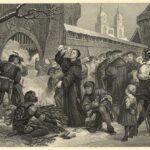
April 2nd, 2018  Hernando de Soto (c1496-1542) Spanish explorer and his men torturing natives of Florida in his determination to find gold. Hand-coloured engraving. John Judkyn Memorial Collection, Freshford Manor, Bath The print above depicts Spanish explorer Hernando de Soto and his band of conquistadors torturing Florida natives in order to extract information on where one might find gold on the peninsula. The print is one of many in a collection of prints that belonged to John Judkyn, a Briton who was a noted antiques dealer, collector, and conservator. I discovered this print on the website for The American Museum in Bath, a British museum that Judkyn helped found and where his life-long collection is housed. Continue reading The American Museum in Britain – From Florida to Bath
April 2nd, 2018 
The following recipes form the most popular items in a nine-course dinner program:
BIRD’S NEST SOUP
Soak one pound bird’s nest in cold water overnight. Drain the cold water and cook in boiling water. Drain again. Do this twice. Clean the bird’s nest. Be sure to take out all feathers and loose particles.
Continue reading Chinese 9 Course Dinner
April 2nd, 2018 
The Effect of Magnetic Fields on Wound Healing
Experimental Study and Review of the Literature
Steven L. Henry, MD, Matthew J. Concannon, MD, and Gloria J. Yee, MD
Division of Plastic Surgery, University of Missouri Hospital & Clinics, Columbia, MO
Published July 25, 2008
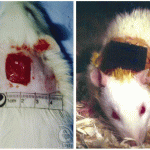
Objective: Magnets are purported to aid wound healing despite a paucity of scientific evidence. The purpose of this study was to evaluate the effect of static magnetic fields on cutaneous wound healing in an animal model. The literature was reviewed to explore the historical and scientific basis of magnet therapy and to define its current role in the evidence-based practice of plastic surgery. Continue reading The Effect of Magnetic Fields on Wound Healing
April 2nd, 2018

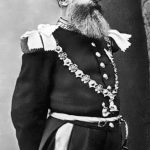
For the somewhat startling suggestion in the heading of this interview, the missionary interviewed is in no way responsible. The credit of it, or, if you like, the discredit, belongs entirely to the editor of the Review, who, without dogmatism, wishes to pose the question as a matter for serious discussion. Since Charles I’s head was cut off, opposite Whitehall, nearly two hundred and fifty years ago, the sanctity which doth hedge about a king has been held in slight and scant regard by the Puritans and their descendants. Hence there is nothing antecedently shocking or outrageous in the discussion of the question whether the acts of any Sovereign are such as to justify the calling in of the services of the public executioner. It is not, of course, for a journalist to pronounce judgment, but no function of the public writer is so imperative as that of calling attention to great wrongs, and no duty is more imperious than that of insisting that no rank or station should be allowed to shield from justice the real criminal when he is once discovered. Continue reading Ought King Leopold to be Hanged?
April 2nd, 2018 
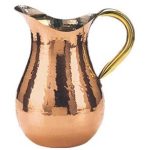
Are you considering purchasing a copper water pitcher for storing drinking water but have questions about the effects on your health?
The following study may help jump-start your research.
Storing Drinking-water in Copper pots Kills Contaminating Diarrhoeagenic Bacteria
ABSTRACT
Microbially-unsafe water is still a major concern in most developing countries. Although many water-purification methods exist, these are expensive and beyond the reach of many people, especially in rural areas. Ayurveda recommends the use of copper for storing drinking-water. Therefore, the objective of this study was to evaluate the effect of copper pot on microbially-contaminated drinking-water. The antibacterial effect of copper pot against important diarrhoeagenic bacteria, including Vibrio cholerae O1, Shigella flexneri 2a, enterotoxigenic Escherichia coli, enteropathogenic E. coli, Salmonella enterica Typhi, and Salmonella Paratyphi is reported. When drinking-water (pH 7.83±0.4; source: ground) was contaminated with 500 CFU/mL of the above bacteria and stored in copper pots for 16 hours at room temperature, no bacteria could be recovered on the culture medium. Recovery failed even after resuscitation in enrichment broth, followed by plating on selective media, indicating loss of culturability. This is the first report on the effect of copper on S. flexneri 2a, enteropathogenic E. coli, and Salmonella Paratyphi. After 16 hours, there was a slight increase in the pH of water from 7.83 to 7.93 in the copper pots while the other physicochemical parameters remained unchanged. Copper content (177±16 ppb) in water stored in copper pots was well within the permissible limits of the World Health Organization. Copper holds promise as a point-of-use solution for microbial purification of drinking-water, especially in developing countries.
April 1st, 2018 
I swapped a parakeet for a red-headed Macaw
That drank my rum and called me paw
I’d rock in my chair, she’d swing on her perch
When the preacher came around she’d pretend it was church
On Saturday mornings when we drove into town
She’d ride on the back of my blue-tick hound
Howling in unison while we made the rounds
She worked out a scheme with a barber named Ed
Alleviating customers of any spare change they had
by rolling over and playing dead
She stayed with me near fourteen years
Drinking rum, always near
Then one day she bolted towards the sun
So I filled her with buckshot from my trusty old shotgun
April 1st, 2018 
WITCHCRAFT, SORCERY, MAGIC AND OTHER PSYCHOLOGICAL PHENOMENA AND THEIR IMPLICATIONS ON MILITARY AND PARAMILITARY OPERATIONS IN THE CONGO
This report has been prepared in response to a query posed by ODCS/OPS, Department of the Army, regarding the purported use of witchcraft, sorcery, and magic by insurgent elements in the Republic of the Congo (Leopoldville). Magical practices are said to be effective in conditioning dissident elements and their followers to do battle with Government troops. Continue reading Paramilitary Operations in the Congo: Witchcraft, Sorcery, Magic and Other Psychological Phenomena
|
|
|